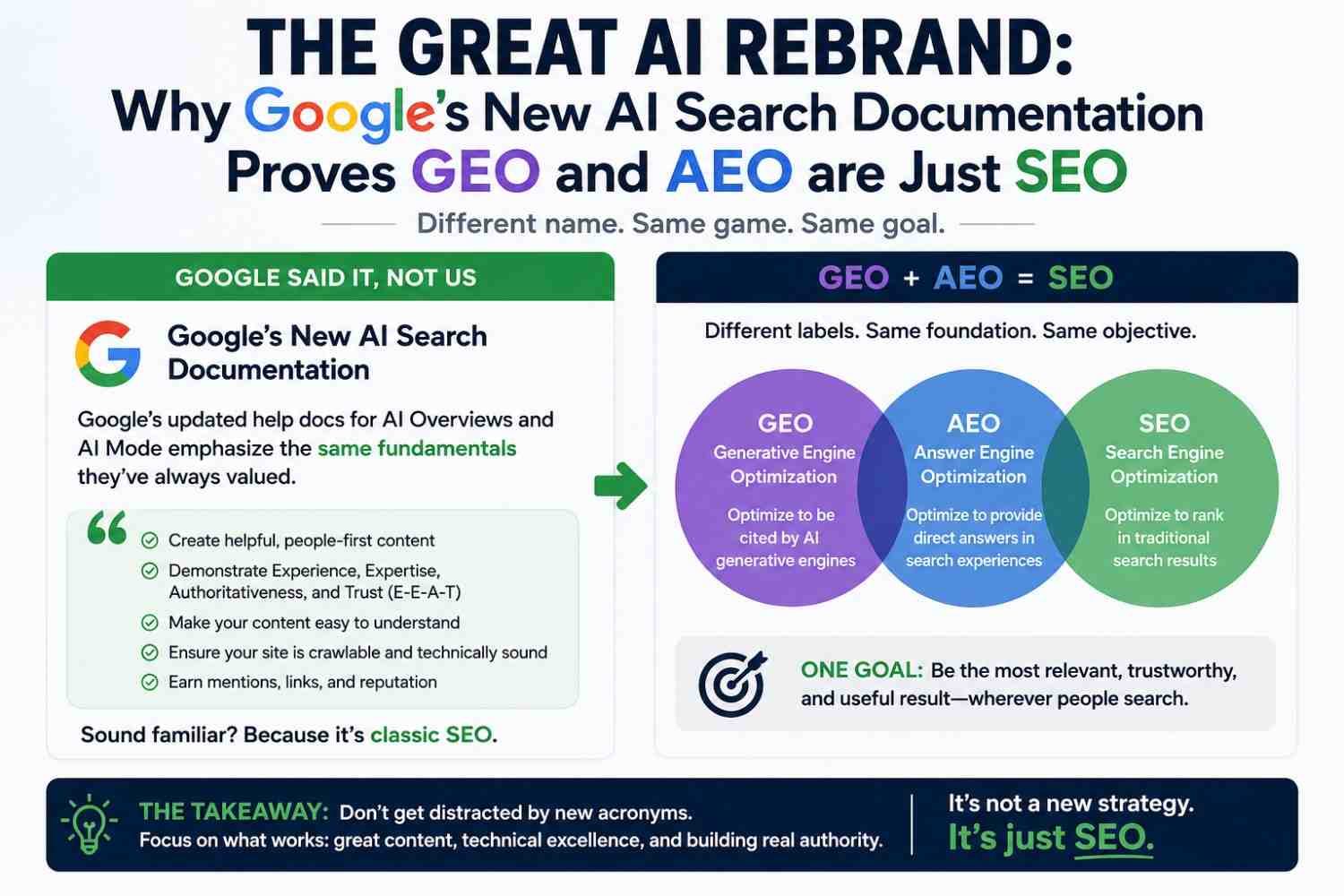
The digital marketing world loves a shiny new acronym. Over the last eighteen months, agencies and content creators have obsessively pivoted toward GEO (Generative Engine Optimization) and AEO (Answer Engine Optimization). Entire frameworks were built around the premise that traditional Search Engine Optimization was dead, replaced by a hyper-specific need to “hack” large language models (LLMs) and Google’s AI Overviews.
Then Google dropped the hammer.
In its official Search Central documentation—titled “Optimizing your website for generative AI features on Google Search”—the search giant offered a definitive reality check for the industry. The core takeaway? GEO and AEO are not new disciplines. They are simply traditional SEO operating at a higher standard.
As Google bluntly puts it:
“From Google Search’s perspective, optimizing for generative AI search is optimizing for the search experience, and thus still SEO.”
The Death of “AI Theater” (What to Stop Doing)
For months, site owners have been sold specialized “AI optimization” packages. Google’s new documentation includes an explicit “Mythbusting” section that effectively invalidates these superficial strategies. If you are currently paying for or implementing any of the following tactics, Google says you can officially stop:
-
Creating
llms.txtor AI-specific files: You do not need machine-readable text files or custom Markdown variants for Google’s AI systems to find and feature your content. -
Artificially “chunking” your content: The belief that you must fragment long articles into tiny, robotic micro-sections for AI to digest is false. Google’s LLMs understand multi-topic pages and can extract context naturally.
-
Rewriting copy for conversational syntax: Google’s algorithms effortlessly process synonyms and broad user intent. Keyword stuffing “long-tail conversational variations” is unnecessary.
-
Chasing inauthentic forum mentions: Spamming Reddit, Quora, or niche blogs with manufactured brand mentions will not trick the AI. Google’s core spam-prevention systems filter these out before the AI layer even reviews the data.
-
Overfocusing on “AI Schema”: There is no hidden, proprietary schema.org code built exclusively for AI retrieval.
How AI Search Actually Works: RAG and Retrieval
To understand why traditional SEO rules apply to AI search, you have to look at the underlying mechanics. Google’s AI features use Retrieval-Augmented Generation (RAG).
When a user inputs a complex prompt, the AI doesn’t just guess an answer from its training data. Instead, it queries the standard Google Search index, pulls top-ranking, authoritative web pages, and synthesizes those pages into a conversational summary.
Because the AI’s “brain” is grounded in the traditional search index, if your content isn’t technically sound enough or authoritative enough to rank in classic organic search, the AI will never see it to cite it.
The Real AI Blueprint: What Actually Matters
Instead of chasing algorithmic hacks, Google explicitly states that site owners should double down on foundational web health and genuine depth.
Classic SEO Baseline ──► High Extractability ──► Non-Commodity Value
(Crawlable & Fast)        (Semantic HTML)          (First-Hand Data)
To earn real estate in Google’s AI Overviews and AI Mode, prioritize these three pillars:
1. Focus on “Non-Commodity” Content
Google draws a sharp line between commodity information (e.g., “5 Tips for Buying a House”) and non-commodity content (e.g., “Case Study: How We Waived Our Home Inspection and Saved $20k”). AI models already know the basic, generic answers. To be cited, you must provide original research, primary data, unique expert analysis, or verifiable first-hand experience (the “Experience” in E-E-A-T).
2. Design for High Extractability
While you don’t need to split your pages into fragments, your formatting must be clean. Use a logical heading hierarchy (H2, H3), write concise “answer-first” introductory paragraphs, and use bulleted lists or data tables where appropriate. This makes it easier for a RAG model to cleanly extract a passage and display it to the user.
3. Maintain Technical Flawlessness
The baseline requirements remain unchanged. Your site must be cleanly crawlable, free of mass duplicate URLs, fast, mobile-friendly, and capable of rendering JavaScript effectively if you use modern web frameworks.
Summary: A Win for Serious Publishers
Google’s official stance is a massive relief for legitimate digital marketers and businesses. By folding GEO Services directly under the umbrella of traditional SEO, Google has stripped away the gimmicks.
The strategy for winning the AI era isn’t about learning a secret machine language; it’s about doing what great SEOs have always done—building clean, fast websites that answer human questions better than anyone else on the internet.